Tuesday, July 9, 2024

Difference between ethics and Morality with examples.

 Difference between ethics and Morality with examples.

    What is ethic:

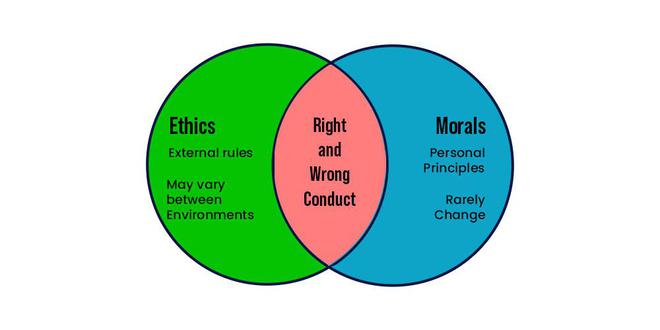
    Ethics are a system of moral principles and the rules of conduct that arise from them. Ethics are a set of moral principles that determine right or wrong behaviour. Ethics refers to an individual’s moral beliefs or principles which govern his or her conduct. Ethics deals with right and wrong in general as well as questions about how one should act towards other people (eg., confidentiality). 

    What is Morality?

    Morality is often used to refer to a person’s moral standards for himself or herself. For example, someone might be said to have high moral standards if he or she follows strict ethical rules such as those found in religious texts like the Bible or Quran. Many of these codes of conduct encourage people to behave in ways that maintain order and peace in society, and that protect the rights and safety of others.
    Relation Between Ethics And Morals

    Relation Between Ethics And Morals

    Where does Morality come from?

    There are a few different schools of thought on where morality comes from. Some people believe that it is innate, something we are born with. Others believe that it is something that is learned through experience and socialization. And still, others believe that it is a combination of both nature and nurture. 

    Ethics vs. Morals

    1. Morals are what you believe, while ethics are what you do. You can have conflicting morals and ethics, like believing stealing is wrong but doing it anyway.
    2. Morals are often based on religion or culture, while ethics are based on logic and reason. This means that you can have different ethical systems even if you share the same morals.
    3. Morals usually deal with personal conduct, while ethics deal with professional conduct. For example, a doctor may consider euthanasia to be morally acceptable but ethically unacceptable because of their position as a doctor.
    4. It’s possible for someone to live by their moral standards without ever having any conflicts with their ethics because morality deals more with how we should behave in our day-to-day lives, while ethics looks at all actions in general – both good and bad. 

    Difference Between Ethics and Morality

    1. Ethics are a formal system of beliefs that guide our behaviour, while morality is more personal and can vary from individual to individual.
    2. Ethics are usually based on logical reasoning and a shared set of values, while morality is often based on gut instinct or religious beliefs.
    3. Ethics tend to be more objective, while morality is often subjective.
    4. Ethics are universal, while morality is often culture-specific.
    5. Ethics are transcendent; they govern all aspects of life. Morality deals with specific issues such as politics, economics, religion and family matters. When someone does something immoral, it usually relates to one of these specific areas. In contrast, ethics applies universally to every aspect of life and when someone does something unethical, it has more implications than just in one area.
    6. Ethics applies to groups and organizations, while morality applies to individuals. As a result, ethical practices don’t always mesh well with organizational cultures and vice versa. 
    7.  Ethics asks people to think about what they do before they act; morality asks people to examine their actions after the fact. For example, someone might have had an opportunity for an extramarital affair but resisted because it would have been unethical rather than because it would have been wrong. Or perhaps somebody might give money to charity because they believe it is the right thing to do, not because they fear eternal damnation. 
    8. In terms of thinking through what we should do in certain situations, ethics tells us how we should behave while morality only tells us if we did the right thing once we’ve behaved in some way. 
    9. Ethics will help you determine whether your behaviour was good or bad, while morality may help you decide whether your intentions were good or bad. 
    10. Both ethics and morality play important roles in shaping human civilization.

    Conclusion – Ethics vs Morality

    Ethics and morality are related concepts concerned with distinguishing right from wrong, they have nuanced differences in terms of their scope, origin, and application. Morality is more personal and subjective, often rooted in individual values and beliefs, whereas ethics tends to be more formal, external, and context-specific. Nevertheless, both play essential roles in guiding human behavior and decision-making.

    Quranic Verses on good character and virtue.


    The Holy and Most Noble Quran, as most readers may already know, is a book that was delivered piecemeal to humanity and covers all its needs – from answering questions regarding the existential crises of individuals, to outlining precious and divinely-ordained laws concerning ecological stewardship, to making clear what is right and wrong. Additionally, the Quran also addresses the down-to-earth and practical aspects of day to day living, clearly articulating Allah’s expectations for the believer as he or she traverses daily life in community.


    What does it mean to have good character?

    In Islam, to have good character means, in a nutshell, to embody godly justice and righteousness, to exhibit the moral qualities exhibited by the Prophet Muhammad (pbuh), and to show kindness to all living things on this planet. The underlying essence of good character and manners is love, love for the creatures of Allah motivated by a profound love for the Divine. The Sufi mystic Rabia of Basria articulated this ideology best when she humbly walked through the streets of Iraq with a flaming torch in her right hand and a pale of water in her left hand, proclaiming: “I want to put out the fires of hell, and burn down the rewards of paradise. They block the way to Allah. I do not want to worship from fear of punishment or for the promise of reward, but simply for the love of Allah.”

    This article does not even begin to scratch the surface of the vast amounts of Islamic teachings on the importance of good character, the monumental corpus of etiquette and orderly conduct based off the Quran and Hadith, and the fatwas given on miscellaneous issues of daily life. My prayer is that the following verses will serve to give the reader a general framework with which to understand the Quranic ideals for the overall righteous conduct and godly behavior expected of humanity, and particularly of the believers.


    Verse 1: Purity and Cleanliness

    “Allah loves those who keep themselves pure.”

    (Quran 9:108)

    In Islam, hygiene, sanitation, and purity are religious acts in and of themselves. The Arabic word for this is tahara, which outlines and explicitly describes the methodology for achieving this state of ritual purity. There are three primary ideas underlying this methodology:

    1. Certain bodily acts produce a state of ritual impurity (i.e., sexual intercourse, ejaculation, urination, or defecation).
    2. Certain spiritual acts will defile an individual (i.e., sins such as theft or lying).
    3. Certain physical substances such as pork and blood will render a person, space, or object unclean.

    In Surah al-Ma’ida, verse 6, one finds detailed instructions on how to perform the ritual purification known as wudhu. The Prophet (pbuh) was recorded to have said that prayer is not accepted without purification[i], and that cleanliness is half of faith[ii].

    It has been said that one can discern a lot about the inner state of an individual by the state of their outer world, hence, many self-help books will suggest making your bed in the morning, taking care of your physical health, and cleaning your room regularly. Prior to the rise of modernity, both the Quran and the lifestyle of Muhammad (pbuh) encouraged certain customs, behaviors, and activities called adab, which resembled holistic ways of contributing to the betterment of humans and their personal development rather than resembling religious laws and divine prohibitions. Some of these adab include customs like filling a stomach a third for food, a third for water, and a third for air[iii]; regularly cleaning the nostrils, mouth, and teeth; and waiting for the invitation of the host rather than intruding in on someone unbeknownst to them[iv].

    While the aforementioned examples may not seem to have much to do with ritual purity, by caring for our physical bodies and appearances, we are showing that Islam is much more than just a religion – it is a lifestyle that embodies everything from how we dress to how we eat to how we interact with our communities. Much more than being a list of dos and don’ts, Islam provides the Muslim with wise teachings on how to keep oneself pure and undefiled in practical matters.


    Verse 2: Integrity in Worldly Affairs

    “Mention too, in the Qur’an, the story of Idris. He was a man of truth, a prophet.”

    (Quran 19:56)

    The prophets in the Quran serve as concepts and models of righteousness and its many different facets. For instance, Moses exemplifies justice through the liberation of his people from Pharaoh; Noah represents obedience which saved him and his family from the flood. Idris, an enigmatic figure mentioned twice in the Quran, was elevated ‘to a lofty station’ as a result of his truthfulness. Various traditions (both Muslim and Jewish) embellish him as a philosopher and mystic – but it is commonly accepted that he was an exemplar model of sincerity, honesty, and wisdom, all of which are attributes intimately linked with truth.

    In his own life as an entrepreneur and businessman, the Prophet began as a poor orphan who had started trading with his uncle and developed into a well-known and highly respected salesman as a result of his honesty and fair dealings. He was known as Al-Sadiq (the Truthful) and Al-Amin (the Trustworthy) among the Meccans. But why be honest, even when we will not suffer any serious damage to our own integrity or spirituality? What is wrong with a little white lie here and there if nobody gets hurt? Dan Ariely, professor of psychology and behavioral economics at Duke University, offers three reasons:

    1. Even telling a small lie risks ruining our reputation.
    2. Telling one lie often leads to telling another, thus triggering a complex network of falsehood.
    3. The consequences of dishonesty are risky and unpredictable, potentially ruining relationships and placing us in emotionally difficult areas[v].

    “You must be truthful, for truthfulness leads to righteousness and righteousness leads to Paradise. A man will keep speaking the truth and striving to speak the truth until he will be recorded by Allah as a Siddiq (speaker of the truth). Beware of telling lies, for lying leads to immorality and immorality leads to Hellfire. A man will keep telling lies and striving to tell lies until he is recorded by Allah as a liar.”[vi]


    Verse 3: Repel Evil with Good

    “Good and evil cannot be equal. Repel evil with what is better, and your enemy will become as close as an old and valued friend.”

    (Quran 41:34)

    At the time this verse was revealed, the Prophet (pbuh) and his companions were being persecuted in every possible way as a result of their emigration from the country. Mischievous and wicked people (namely the polytheists and the Quraish) uttered lies against the Muslims, evil defamations were being concocted in order to destroy the Prophet’s (pbuh) reputation. Accusations and anti-Muslim propaganda planted seeds of doubt among the Meccans in order to discourage them from supporting the mission of Allah. Despite the chaos and hatred that surrounded him, Allah instructed this chosen community to repel evil with good.

    Elsewhere, the Quran reveals to the reader that humankind has a proclivity to hate evil, even though humanity has contributed to its propagation. The Quranic prescription against hatred and evil is not simply good, but a superior goodness marked by kindness and love in the face of mankind’s wicked machinations against God. To remain quiet as a response to an insult is good. However, to express blessings and good wishes for the one who insults is a superior goodness that puts to shame the words of your enemy. In the natural world, the sweetness of water puts out the destructive potential of fire, and good habits smother devilish ones. The challenge of every Muslim is to be an embodiment of the goodness of Allah in order to battle evil. Sayyid Abul A’la Mawdudi once said that “devil-incarnates are as few in the world as the embodiments of goodness are.”[vii]


    Verse 4: The Value of Kindness

    “O Messenger of Allah! It is a great Mercy of God that you are gentle and kind towards them; for, had you been harsh and hard-hearted, they would all have broken away from you.”

    (Quran 3:159)

    Throughout the Quran, the mercy of Allah is referred to hundreds of times. In another verse, Allah says, “My mercy embraces everything,” which encompasses everything from the farthest reaches of the universe to the life of a single ant. In context, this verse is referring to the personality of the Prophet (pbuh), establishing that he must exhibit the qualities of gentle manners, kindness, forgiveness, and generosity in order to serve the greater purpose of educating humanity. As the leader of the Muslim community during his time on earth, Muhammad (pbuh) went through phases of rejection, growth, and correction – when anyone, leaders in particular, takes a ‘hard-hearted’ or arrogant approach to life, he or she is not fit to lead a community nor to communicate the message of Islam.

    Whereas punishment provides a sense of justice, forgiveness provides the emotional relief that soothes relational burns among people. Modern psychology takes a more balanced approach that falls in line with the Quranic view, suggesting a restorative justice model:

    “When we try to forgive major transgressions without first exacting justice, the result is harmful not only to our own sense of self-worth but also to the relationship as a whole. Forgiveness without justice leads to lingering resentment on the part of the victim. Further, it fails to communicate the seriousness of the transgression to the offender, so nothing has been done to keep the problematic behavior from recurring in the future.”

    [viii]

    This model, which takes into account both kindness and justice, is seen in the noble and godly leadership of the prophets of the Quran.


    Verse 5: Hospitality to Strangers

    “When they [the angels] came to him [Abraham], they said: ‘Peace’; he said: ‘Peace also be to you; (you seem to be) a group of strangers.’”

    (Quran 51:25)

    The act of hospitality is an act of compassion in which one puts oneself into the situation of the Other, recognizing (whether cognitively or emotionally) that this is a person in need of something. It is easy to help a friend or family member; it is much more difficult to help someone you don’t know, especially when there is no guarantee that you will receive some sort of immediate reward or gratification for your hospitality. The objective of this verse is to exemplify Abraham’s supreme generosity to strangers, without asking for anything in return. Elsewhere in the Quran [41:30], the reader learns that the presence and activity of the angels is not limited to the spiritual realm, but occurs here on earth as well. In the context of hospitality and acting out one’s faith, this verse poses the following question to the reader: Who knows if you yourself are entertaining angels without being aware of it? The angels appeared in the presence of Abraham, and he served them unaware of their divine nature; could not the Lord of the Worlds present us with the same challenge?

    Traits and quality of a good Muslim as per Quran.


    The Characteristics of a Believer

    The Holy Prophet Muhammad (s) describes the believer in his sermon:

    “Blessed is he who earns his living through lawful ways and he whose inward status is good, outward is decent; spends his surplus wealth in charity; abstains from excessive talking; people remain safe of (any) evil from him; he treats others with justice. Surely whoever believes in Allah fears Him, and whoever fears Allah guards himself against the evils of this world.”1

    Let us ponder on the meanings, thoughts, and instructions of these everlasting words of the Glorious Messenger of Allah (s) in order to understand and apply them in our daily life. We can learn morals, good behaviour, laws, and a whole system of life from Prophet Muhammad (s) who made clear the right path for us in order to guide us, so that we could purify ourselves and inform the rest of society.

    Surely, the Messenger of Allah Muhammad (s) wanted, through his sermon, to teach us various things. Among them are:

    1. That congratulations are for the servant of Allah, who makes his living through lawful means and does righteous deeds; and, as the result, he leads a fulfilling and successful life both in this world and in the hereafter.

    The Messenger (s) certainly wants us to earn our living through lawful ways and avoid what is unlawful.

    2. That congratulations are for whoever improves his moral behaviour. Indeed, happiness and a good life are found where there are good morals and other people are treated well. These are well-known attributes of a believer and of a praiseworthy character.

    Congratulations thus are for whoever improves his own character and thus improves his life.

    3. In the sermon, Holy Prophet Muhammad (s) praises faithful men who are simple-hearted, i.e. he who bears no evil in his heart towards anyone nor is hypocritical, hasty or deceitful, but whose heart is pure and his self is cleansed against any filth or evil.

    4. The believer of whom the Messenger (s) praises his character and attributes is also the one who spends whatever he can out of his own wealth in charitable and benevolent programmes, and deeds, seeking Allah's pleasure.

    A believer is the one who strives to obtain his living through lawful means and not depend on others, dissatisfied with unemployment and squandering time. He uses his income thriftily on himself and provides for his family according to their needs, while he spends the rest in the cause of Allah. Never is any money amassed for its own sake or deprived from helping the poor and needy as this is against Islam.

    5. Another characteristic of a believer who deserves a good life and pleases Allah is in the way of speaking. Controlling the tongue eliminates all idle chatting and presents one from interfering in or provoking any hostility. A believer says nothing which displeases Allah, the Almighty and instead voices what is useful in knowledge and advice, in uttering what is good and saying what is righteous.

    6. A believer never does harm to others. People will feel safe and secure when they live with a believer because he is the doer of good, who shows his love of good by performing it and his dislike of evil by avoiding it.

    Apart from this, he is also just and never forfeits the rights of others. He respects another's rights and abides by them.

    7. In the same sermon, the Messenger of Allah (s) explains that belief in Allah and knowing Him makes a man fearful of committing sins and evil deeds. He, who fears Allah, never becomes over-involved with the life of this world in which people strive against each other for mere material gain. Instead he directs himself towards life in the Hereafter and strives for its sake.

    In Summary

    A believer is one who deserves Allah's pleasure and for him there will be a good life and happiness in this world and in the Hereafter. The believer is the one in whom the following characteristics are found:

    1. Doing what are lawful and righteous deeds.

    2. Having good morals and treating people with respect.

    3. Having a purified heart and soul, neither hating others nor being hypocritical.

    4. Spending whatever he has out of his wealth in the cause of Allah i.e. in the fields of charity.

    5. Being offensive to no one.

    6. Causing no harm to others.

    7. Respecting other people's rights.

    8. These characteristics are only found in truly faithful persons who know Allah well and fear His punishment because those who know Him do not think much of this world's life, and wish only to achieve the performance of as many good deeds as possible in it, in order to be rewarded in the life hereafter.

    Characteristic of Muslim as per Quran.


    10 Qualities of a Believer Described in the Qur’an

    Successful indeed are the believers. Those who offer their Salat (prayers) with all solemnity and full submissiveness. And those who turn away from Al-Laghw (dirty, false, evil vain talk, falsehood, and all that Allah has forbidden). And those who pay the Zakat . And those who guard their chastity (i.e. private parts, from illegal sexual acts) except from their wives or (the captives and slaves) that their right hands possess, for then, they are free from blame. But whoever seeks beyond that, then those are the transgressors. Those who are faithfully true to their Amanat (all the duties which Allah has ordained, honesty, moral responsibility and trusts etc.) and to their covenants. And those who strictly guard their (five compulsory congregational) Salawat (prayers) (at their fixed stated hours). These are indeed the inheritors. Who shall inherit the Firdaus (Paradise). They shall dwell therein forever. — Qur’an 23[Al-Muminoon]: 1–11

    Photo by Clark Tibbs on Unsplash

    The Mu’meen is a true believer — the one who believes in God as One and stays firm with this proclamation. He was as described by God in the above mentioned verses of the Qur’an. A whole chapter was revealed in the holy book in honor of the believers. If you are a Muslim, then this is one of the greatest favor bestowed upon you. The guidance to Islam is not by your might, it’s only as destined. Do not feel safe in this state as many Muslims do. Neither should you look down on those who are non-Muslims as doomed — the table can turn around at anytime. For it’s only the Mu’meen whom Allah has assured of success. It’s quite pathetic that many Muslims are satisfied with the status quo of being ordinary Muslim. Little efforts do we put, in striving to become Mu’meen. The Mu’meen is simply a better Muslim and the best of Muslim is the Muhsin. Hence, the Mu’meen is never satisfied with this state until he strives to become a Muhsin which is the highest state of eeman.

    To become a Mu’meen, you need to strive in keeping up with these distinctive traits of the believer enumerated above and elaborated below:

    1. Believe in the unseen: The first characteristic of a believer is to believe in Allah — The One True God who created everything. It is this believe that propels other articles of faith which cannot be seen. This includes the believe in Angels, prophets, revelations, resurrection and destiny — either good or bad. And this is why God puts it clear thus:

    This is the Book (the Quran) whereof there is no doubt, a guidance to those who are Al-Muttaqoon (the pious and righteous persons who fear Allah much). Those who believe in the Ghaib (Unseen) and perform As-Salat (Iqamat-as-Salat), and spend out of what we have provided for them (i.e. give Zakat , spend on themselves, their parents, their children, their wives, etc., and also give charity to the poor and also in Allahs Cause). And who believe in (the Quran and the Sunnah) which has been sent down (revealed) to you (Muhammad Peace be upon him ) and in (the Taurat (Torah revealed to Moses) and the Injeel (Gospel revealed to Jesus), etc.) which were sent down before you and they believe with certainty in the Hereafter. (Resurrection, recompense of their good and bad deeds, Paradise and Hell, etc.). They are on (true) guidance from their Lord, and they are the successful. — Qur’an 2[Al-Baqarah]:2–5

    2. Adhere strictly to God’s injunctions: Indeed man was created weak and the purpose of his creation is to worship God. Of all God’s creation, it’s only mankind and jinn that have freewill. It means you can either choose to worship God the right way or not. This is nothing but a trial, in order to test who will fulfill the obligation of submissiveness. The true believer understands he has no choice other than to submit and remain steadfast until the last breathe is taken. God says:

    Blessed is He in Whose Hand is the dominion, and He is Able to do all things. Who has created death and life, that He may test you which of you is best in deed. And He is the All-Mighty, the Oft-Forgiving. — Qur’an 67[Al-mulk]:1–2

    3. Guard against His forbidden: The believer tries as much as he can to stay away from what is unlawful as enjoined by God. No matter how difficult or confusing it may seem, he’d rather avoid it owing to doubts. This was well stated by the Messenger of God in the collections of Imam Bukhari: “verily, every king has a sanctum and the sanctum of Allah is his prohibitions.”

    4. Show humility and mercy to people: The believers are humble and kind in character. They exhibit the most beautiful traits in human personality. The best example can be seen from the life of Muhammad (peace be upon him). Many people came to accept Islam from his excellent traits. He once said: He is not one of us, the one who is not merciful to the young and respectful to the elderly (Tirmidhi).

    In another narration from Jubayr ibn Mut’im that a man came to the Prophet (peace and blessings of Allaah be upon him) and said: O Messenger of Allaah, which part of the land is worst? He said: I do not know." When Jibreel (peace be upon him) came to him he said: "O Jibreel, which part of the land is worst?" He said: "I do not know, until I ask my Lord, may He be glorified and exalted." Jibreel went away, and stayed away for as long as Allaah willed that he should stay away. Then he came and said: "O Muhammad, you asked me which part of the land is worst and I said I did not know. I asked my Lord, may He be glorified and exalted, and He said: Its markets." (Ahmad)

    5. Unshakable trust in God: The believers know fully well that everything -good or bad- comes to be by God’s will. No matter how difficult a situation may be, a true believer will not compromise his faith for a piece of cake. This is why God reassures the believer in the following verses:

    …And whosoever fears Allah and keeps his duty to Him, He will make a way for him to get out (from every difficulty) .And He will provide him from (sources) he never could imagine. And whosoever puts his trust in Allah, then He will suffice him. Verily, Allah will accomplish his purpose. Indeed Allah has set a measure for all things. — Qur’an 65[At-Talaq]:2–3

    Photo by Iswanto Arif on Unsplash

    6. Endure trials with patience: Tribulations are part of life, this has been mentioned several times in the Qur’an. No believer will make a claim to faith without been tested. This test comes in a form of trial and God revealed the solution:

    O you who believe! Seek help in patience and As-Salat (the prayer). Truly! Allah is with As-Sabirin (the patient ones, etc.). — Quran 2[Al-Baqarah]:153

    God’s apostle has this in addition: On the authority of Suhaib (may Allaah be pleased with him) he said: The Prophet (peace be upon him)said: “Amazing is the affair of the believer, verily all of his affair is good and this is not for no one except the believer. If something of good befalls him he is grateful and that is good for him. If something of harm befalls him he is patient and that is good for him” (Muslim)

    7. Excellence as a virtue: Bare in mind that no one is perfect, for perfection belongs to Almighty, the All-Wise. Everything a believer does is executed excellently well. This is as encouraged by the prophet Muhammad (peace be upon him):

    Shaddad ibn Aws reported: The Messenger of Allah, peace and blessings be upon him, said, “Verily, Allah has prescribed excellence in everything. If you have to kill, then kill in the best manner. If you have to slaughter, then slaughter in the best manner. Let one of you sharpen his knife so his animal is spared of suffering.” (Muslim)

    8. No compromise on justice, even against oneself: This is a distinctive trait of the believer even as seen among common Muslims. The prophet (peace be upon him) once told his daughter Fatimah that his love for her will not stop him from executing God’s injunction if she violates the obligation of the Lord of the Supreme Throne.

    Here is a golden admonition from God as found on the walls of Harvard law school:

    O you who believe! Stand out firmly for justice, as witnesses to Allah, even though it be against yourselves, or your parents, or your kin, be he rich or poor, Allah is a Better Protector to both (than you). So follow not the lusts (of your hearts), lest you may avoid justice, and if you distort your witness or refuse to give it, verily, Allah is Ever Well-Acquainted with what you do. — Qur’an 4[An-Nisa’]:135

    9. They strictly guard their obligatory prayers: The believer does not only observe the five daily prayers. He goes the extra mile by doing supererogatory acts of worship — standing in the middle of the night. Allah’s apostle (peace be upon him) was reported to have said: “the coolness of my eyes is in the observance of prayer”. One of his wives cautioned him to have prayed excessively and as a result, he got a swollen feet. He responded to her: “shouldn’t I be a thankful slave of Allah?”

    Verily, the prayer is enjoined on the believers at fixed hours. — Quran 4[An-Nisa’]:103

    10. Indeed! These are the successful onesSuccess is not in having a paying job or all the good things of life. True success is finding yourself as an inhabitant of paradise. The believers are those whom God has promised the supreme paradise.

    On the Day you shall see the believing men and the believing women their light running forward before them and by their right hands. Glad tidings for you this Day! Gardens under which rivers flow (Paradise), to dwell therein forever! Truly, this is the great success! — Qur’an 57[Al-Hadid]:12

    Bye-Line: If you find this piece beneficial, it’s by the will of Allah. It’s no scholarly work and we accept our mistakes. Suggestions are welcomed in making this publication better as well. You are free to share by any means for enlightenment purpose. Kindly give a “click-clap” to enable other readers on Medium see this post. You may follow the publication to get a glimpse of the updates. I hope you’d read from us again next time in sha Allah!